
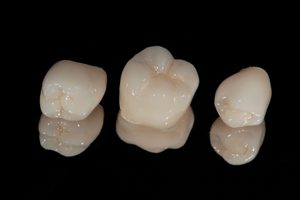
Dental crowns are a versatile way to address a variety of dental concerns. For instance, they can shield a tooth that just underwent a root canal, protect an injured tooth from additional disease or decay, cover an implant, or anchor a bridge to close gaps in your smile from missing teeth.
But these tooth-shaped caps weren’t always as lifelike, comfortable, or long-lasting as they usually are today. Continue reading to learn more about the history of dental crowns so you can appreciate your restoration that much more!
How Old Are the Earliest Dental Crowns?
It’s easy to think of dental prosthetics as a recent invention, but ancient civilizations also wanted to repair damaged or missing teeth. For instance, it’s been discovered that the Etruscans of ancient Italy made artificial teeth from gold and other precious materials between 166 and 201 AD.
However, these early restorations were probably intended as status symbols rather than to function normally, because they were fragile and likely weren’t durable enough for biting and chewing. It’s been suggested that, in some cases, people may have extracted teeth rather than losing them naturally so they could replace them with ones made from precious metals.
How Did Dental Crowns Evolve?
Dentistry didn’t evolve much until the Middle Ages, when a Guild of Barbers was established in France around the 1200s to 1300s. This group consisted of surgeons with medical training and lay barbers who performed hygienic services, including filing down teeth or applying acid washes to whiten them.
Unfortunately, these early treatments caused tooth decay, increasing the need for restorative solutions, like dental crowns. Then, in the 1500s, Dr. Ambrose Pare, the ‘father of modern surgery’, wrote The Little Medicinal Book for All Kinds of Infirmities of Teeth, which included basic instructions on dental drilling, extractions, and building and placing crowns.
Then, in 1905, Dr. Charles H. Land patented the porcelain “jacket” crown, which eventually evolved into the lifelike prosthetics we’re familiar with today.
What are Dental Crowns Like Today?
Contemporary dental crowns can potentially be made from different materials, such as blended metals, porcelain, or porcelain-fused-to-metal. Thanks to ongoing advances in technology, materials, and techniques, they are more beautiful, accurate, and comfortable than in the past.
For instance, many dentists today utilize advanced digital impressions to provide dental crowns that fit like a glove and are less likely to be damaged or dislodged. And the ceramic they’re often made from can be crafted to match the size, shape, and tone of your natural enamel to blend into your smile beautifully.
If you have questions about your dental crown, like what it’s made from or if it’s still in good condition, you can learn more by contacting your dentist!
About the Practice
Patients at Justyna Laska, DDS, benefit from 3 friendly dentists who take pride in supporting the community by helping them build happy, healthy smiles. Dr. Laska, Dr. Belken, and Dr. White collaborate to offer a complete menu of top-quality services, including providing lifelike dental crowns, to meet the unique needs of children and adults alike. Their caring approach, combined with advanced technology, improves comfort while delivering beautiful, long-lasting results. You can request an appointment on the website or call (817) 737-9555.